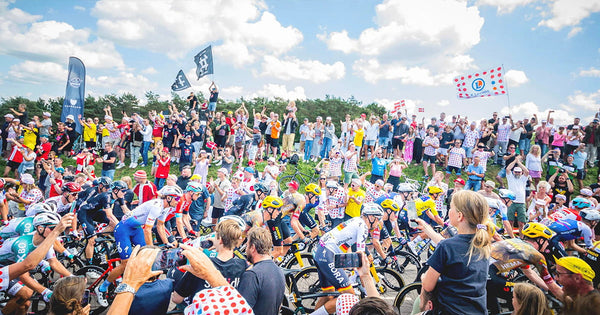
The Tour de France. Le Tour. The 'yellow one!' Whatever you call it, the biggest race in cycling is back and it's destined to be another legendary edition. Expect five mountain ranges, a double Alpe d'Huez, roadside picnics and a nation holding its breath.
The Tour de France is the second of the Grand Tours and the biggest bike race on the planet, crossing the most beautiful & iconic regions of France. The 3 week race sees the world's best cyclists battle it out to win the most famous jersey in sport... The Maillot Jaune (yup, that's the yellow one!).
Now it's important to state that this is no ordinary cycling event. It has an illustrious history stretching back 123 years (circa 2026), and as the largest free-to-watch annual sporting event on earth, it draws over 10 million fans to the roadside every July. That said, if you're new to the sport or the event then don't worry about some of the complexities. We'll cover everything you need to know in this article. So let's start with the basics:
What is a Grand Tour?
In the world of cycling there are three major professional cycling races. The Giro d'Italia (in May), the Tour de France (in July) and the Vuelta a España (in August). Together they are known as the 'Grand Tours', and they all follow a standard format: 3 weeks of racing across a variety of stages and 2 rest days. Hit the logo's here to check out the home pages for each:
How do you win a Grand Tour?
The Grand Tours are seen as the toughest & most prestigious races in the professional peloton, and winning one is no easy feat. But one of the coolest things about the Grand Tours is that there's actually more than one way to win. Let me explain ...
Cycling is a team sport and just like in football or rugby, each team gives their cyclists specific roles based upon their skill set. This leads riders to become specialists in their chosen category, which are called Classifications. The 3 main classifications are:
- General Classification ('GC' for total time accrued across all stages. The lowest time at any stage is the leader)
- Mountains (specialist climbers win points for their position over mountain tops. Highest points at any stage is the leader)
- Points (Awarded to specialists who 'sprint' small dedicated sections within each race. Points are awarded to the fastest, and the highest accrued points at any stage is the Leader)
At the end of each day's racing a winner is declared for each of the Categories, and they are awarded the relevant 'Leaders Jersey' to wear the next day. This really helps the fans, as we can easily spot the current leaders amongst the peloton!
The Tour de France in 2026
- This is the 113th edition & runs from 4th July to the 26th July
- With 21 Stages
- Starts in Barcelona, Spain
- Ends in Paris, France
- Covering 3,333km (2,071 miles)
- Including over 54,450 vertical metres of climbing
The 2026 Tour is the 113th edition of the race, and only the third time in its history the Grande Boucle has rolled out from Spain — San Sebastián opened the 1992 Tour, Bilbao started the 2023 edition, and now Barcelona joins the list. The Catalan capital hosts a 19.7 kilometre team time trial on day one: the first time the Tour has opened with a TTT since 1971. From there the race crosses into France for what's been billed as the hardest opening week in modern Tour history, then works its way across five mountain ranges — the Pyrenees, the Massif Central, the Jura, the Vosges and the Alps — before the final stage into Paris on Sunday 26 July.
It's a route built 'in crescendo', in the words of race director Christian Prudhomme. Thirty major categorised climbs, six of them new to the race. Just one individual time trial, placed deep in week three. Eight mountain stages with five summit finishes: Gavarnie-Gèdre in the Pyrenees, Plateau de Solaison, Orcières-Merlette, and then the headline act — Alpe d'Huez twice, on consecutive days. That has never happened in 113 editions of this race. Stage 19 takes the classic route up the 21 hairpins. Stage 20 is the queen stage of the year: Col de la Croix de Fer, the Télégraphe, the mighty Galibier at 2,642 metres (the roof of the race), the narrow Col de Sarenne, and then the Alpe one final time. Over 5,600 metres of climbing in a single day. The Tour will be won — or lost — right there.
And then Paris. After the roaring success of 2025, the final stage once again sends the peloton over the cobbled climb of Montmartre — three times — before the traditional sprint on the Champs-Élysées. A finale that's no longer entirely ceremonial. Someone in yellow will still need to keep their elbows out.
The contenders going in: Tadej Pogačar (UAE Team Emirates XRG) is the favourite: the world champion is chasing a record-equalling fifth Tour title, and his spring suggests he's lost none of his edge. The man most likely to stop him is Jonas Vingegaard (Visma–Lease a Bike), arriving straight off a dominant Giro d'Italia win and attempting the Giro–Tour double. Remco Evenepoel (Red Bull–BORA–hansgrohe) brings the best time trial in the world to a route with only one. And keep an eye on Paul Seixas, the 19-year-old French prodigy making his Tour debut. The sprinters' line-up is led by Jonathan Milan, Tim Merlier, Jasper Philipsen and Paul Magnier.
When is the Tour de France?
The second of the Grand Tours kicks off in early July, lasting for 3 weeks with 21 race days and 2 rest days (this year on the 13th and 20th of July). The race for the Maillot Jaune wraps up in Paris on the final Sunday of the month, and the Vuelta a España follows about a month later in August.
Where is the Tour held?
No surprises here - the Tour is hosted all over France! But there are some key regions that tend to be included regularly. Look out for the Pyrenees and the Alps for the high mountains, the Massif Central, Vosges and Jura for the punchy middle weeks, and of course the final day on the Champs-Élysées in Paris. Occasionally the opening few days are held outside of France, and in 2026 the first three stages are in Catalonia, Spain.
How big is the Tour?
184 riders across 23 Teams (so 8 riders per team), will ride 3,333km with over 54,000 vertical metres of climbing. Gulp...
Good to know:
Whilst the Giro d'Italia, Tour de France and La Vuelta are incredibly different, varied and with their own histories & cultures... Today they all have exactly the same framework for competition - with 184 riders, across 23 teams of 8. They are also equally distanced at approximately 3,500km. One thing that sets 2026 apart though: at 54,450 vertical metres, this Tour out-climbs this year's Giro by a full 5,000 metres. It's one of the toughest routes ever drawn.
A little history of the Tour de France
Just like the Giro d'Italia, the Tour de France has its roots in the world of newspapers. Way back in 1903 there was a notable lack of internet availability, and so people got their daily dose of news from the papers. A sports daily called 'L'Auto' was locked in a circulation war with its rival 'Le Vélo', and a young journalist named Géo Lefèvre pitched a mad idea over lunch: a race around the whole of France, the longest and hardest ever staged. His editor Henri Desgrange went for it, and the Tour was born. But the coolest thing to know is that L'Auto was printed on yellow paper, and this is where the famous Maillot Jaune / Yellow Jersey (for the GC leader) was derived from — first awarded in 1919 so the fans could spot the race leader on the road.
What makes the Tour unique?
If the Giro is famed for its chaos, the Tour is famed for its sheer scale. This is the biggest annual sporting event in the world — broadcast to around 190 countries, with over 10 million fans lining the roads across the three weeks. And every single one of them watches for free. There's no ticket, no turnstile, no stadium. Just a mountainside, a picnic, and a wall of noise when the race comes past. One minute of racing, six hours of atmosphere — and somehow it's still worth every second.
Then there's everything around the race. The publicity caravan — a 10km parade of sponsor floats that rolls through ahead of the peloton, hurling free caps and keyrings at the crowds. The campervans that stake out hairpins on the Alpe a full week early. Bastille Day, when every French rider in the race goes up the road with the hopes of an entire nation on their back. For three weeks in July, France doesn't just host the Tour - France is the Tour. In the face of such scale, such history, and such joy from the roadside - it's almost impossible not to get caught up in the yellow whirlwind year after year!
A guide to the Tour de France Jerseys
For the General Classification:
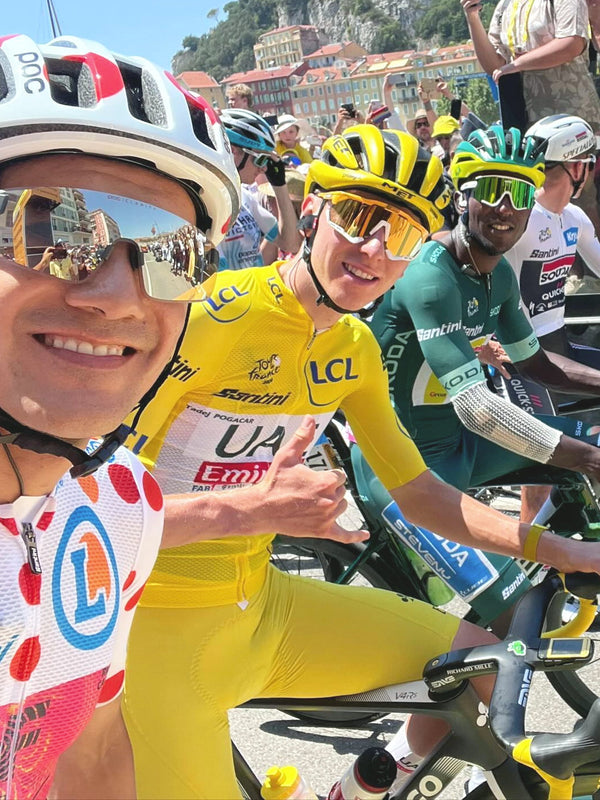
Yellow Jersey (Maillot Jaune)
This is all about finishing the stages as quickly as possible. The winner of the first stage becomes the leader of the General Classification ('GC') and is awarded the Yellow Jersey to wear the next day. From there everyone's times are recorded and added up day-by-day, giving each rider a total riding time. Whoever has the lowest time at the end of each stage wins for that day, and is awarded the Yellow Jersey (Maillot Jaune) to wear the next day. To spice things up there are also bonus seconds awarded for crossing certain sections first.
- For the Giro d'Italia the GC jersey is pink, and for the Vuelta it is red.
- Great examples of GC riders include Tadej Pogacar & Bradley Wiggins.
For the Points Classification:
The Green Jersey (Maillot Vert)
Is focused on winning & accumulating points through each of the 21 stages. The points scoring system can be a bit complicated, but the key thing to know is that flat finishes carry the biggest hauls, so the Green Jersey almost always ends up on the back of a sprinter. Points are also up for grabs at the intermediate sprint placed in every road stage. Whoever has the highest points score at the end of each race wins the stage points, and is awarded the Green Jersey (Maillot Vert) to wear the next day.
- The scoring at the Tour weights flat stages most heavily — up to 50 points for a flat stage win, scaling down for hillier days — which keeps the competition between the pure sprinters and the all-rounders who can survive the climbs.
- Great examples of Points/Sprint riders include Mark Cavendish (who won the Green Jersey in 2021) & Peter Sagan (who won it a record seven times).
For the Mountains Classification:
The Polka Dot Jersey (Maillot à Pois)
This one focuses on the Climbers, awarding points for the first group of riders to cross Classified Climbs (registered as a certain difficulty and allocated with points as part of the race planning). Tour climbs are graded from Category 4 (the easiest) up to Category 1 and then 'Hors Catégorie' — beyond categorisation — for monsters like the Galibier and Alpe d'Huez. Whoever has the highest Mountain Points score at the end of each race wins the stage points, and is awarded the famous Polka Dot Jersey (Maillot à Pois) to wear the next day.
- The Mountains Classification first appeared at the Tour in 1933, with the polka dot jersey itself arriving in 1975.
- Points aren't always won by the best climber - sometimes an early breakaway (where a rider breaks off the front of the peloton) can win the points before the stronger climbers get anywhere near to the top. Some riders actually specialise in using breakaways to win points, rather than head-to-head climbing!
- Summit finishes and Hors Catégorie climbs carry double points & the most prestige, so riders will often battle particularly fiercely to win them. These are definitely ones to watch!
- Great examples of Mountain/Climber winners include Richard Virenque (who won the Polka Dot a record seven times) & Tadej Pogacar (who won it in 2020 and 2021).
For the Best Young Rider:
White Jersey (Maillot Blanc)
This is another version of the General Classification competition, but reserved for riders under 25 at the start of the year. Fun fact: Tadej Pogacar has won the White and Yellow jerseys together three times.
Extra awards at the Tour
Team Classification
This is the fastest Team overall. It is calculated by combining the top 3 finishers of each team, each day across the 21 stages. Whichever team has the lowest time overall wins, and the leading team wears yellow race numbers (and often yellow helmets) so you can spot them in the bunch.
Intermediate Sprints
There is one of these in every road stage, offering Green Jersey points and bonus seconds part-way through the day. They keep the sprinters' teams working and encourage breakaways on every stage.
Combativity Award
Awarded after every stage to the day's most aggressive rider — usually someone who spent hours in the breakaway. The winner gets a red bib number to wear the next day.
Super-Combativity
The big brother of the daily award: given to the most combative rider of the entire three weeks, and presented on the podium in Paris on the final day.
Souvenir Henri Desgrange
A cash prize for the first rider over the highest point of the entire race, named after the Tour's founding father. In 2026 that's the mighty Col du Galibier at 2,642 metres — crested on the queen stage to Alpe d'Huez. Expect an all out brawl for this one!
Souvenir Jacques Goddet
The sister prize, awarded to the first rider over the summit of the legendary Col du Tourmalet, in memory of the Tour's second director. The Tourmalet features on stage 6 in 2026, on the road to Gavarnie-Gèdre.
The Lanterne Rouge
Not an official prize at all - but the rider who finishes last on GC in Paris is known as the 'Lanterne Rouge' (the red lantern, after the light on the back of a train). Simply making it to Paris is an achievement, and the Lanterne Rouge is celebrated as a cult hero rather than commiserated. We love that.
Recent Men Winners
- 2025 Tadej Pogačar (Slovenia) UAE Team Emirates XRG
- 2024 Tadej Pogačar (Slovenia) UAE Team Emirates
- 2023 Jonas Vingegaard (Denmark) Jumbo-Visma
- 2022 Jonas Vingegaard (Denmark) Jumbo-Visma
- 2021 Tadej Pogačar (Slovenia) UAE Team Emirates
- 2020 Tadej Pogačar (Slovenia) UAE Team Emirates
- 2019 Egan Bernal (Colombia) Team Ineos
- 2018 Geraint Thomas (UK) Team Sky
- 2017 Chris Froome (UK) Team Sky
- 2016 Chris Froome (UK) Team Sky
- 2015 Chris Froome (UK) Team Sky
- 2014 Vincenzo Nibali (Italy) Astana
Recent Women Winners:
- 2025 Pauline Ferrand-Prévot (Fra) Visma–Lease a Bike
- 2024 Kasia Niewiadoma (Pol) Canyon//SRAM
- 2023 Demi Vollering (Ned) SD Worx
- 2022 Annemiek van Vleuten (Ned) Movistar
The Tour de France Femmes relaunched in 2022 and runs in early August, the week after the men's race — and in 2025 it delivered a French winner on home roads for the first time. Magnifique.
Wins by country:
- France = 36
- Belgium = 18
- Spain = 12
- Italy = 10
- Great Britain = 6
- Luxembourg = 5
- Slovenia = 4
- United States = 3
- Denmark = 3
- Switzerland = 2
- Netherlands = 2
- Germany = 1
- Ireland = 1
- Australia = 1
- Colombia = 1
And here's the kicker: despite leading the all-time table with 36 wins, France hasn't had a home winner since Bernard Hinault way back in 1985. Forty-one years of hurt — and a 19-year-old named Paul Seixas now carrying the hopes of a nation.
Legends of the Tour
Overall and stage wins at the Tour are career-defining. Only four men have ever won it five times — Jacques Anquetil, Eddy Merckx, Bernard Hinault and Miguel Indurain — and Tadej Pogačar, on four going into 2026, has the chance to join them in Paris this July.
The stage-wins record belongs to Mark Cavendish, whose 35th in 2024 finally edged past Merckx's mark of 34 — a record many thought would never fall. Three names, though, cast a longer shadow over this race than any others:
-
Eddy Merckx
The Cannibal. The most complete rider who ever lived — he attacked everywhere, all the time, and won everything in sight. His 96 days in the yellow jersey is a record no one since has come close to.
-
Bernard Hinault
The Badger. Five Tours, and one of the hardest men ever to race a bike: combative, intimidating, impossible to drop. Also the last Frenchman to win his home Tour, back in 1985.
-
Mark Cavendish
The Manx Missile. No rider in history has won more Tour de France stages - his 35th in 2024 finally edged past Eddy Merckx's 34, a record many had thought untouchable.
Prize Money!
This one must have crossed your mind at some point! Here we can fill that void with some hard numbers and show how the total pot of around €2.3 million in prize money is divided up:
- General Classification Top 3: €500k/€200k/€100k
- General Classification Top 20: from €70k-€1k
- All finishers: take a small finisher's payment.
- Every day wearing Yellow: €500 per day.
So the GC winner pockets half a million euros, plus daily jersey bonuses and any other prizes won along the way.
- Points Classification Overall Win: €25k for the Green Jersey in Paris.
- Every day wearing Green: €300.
- Mountain Classification Overall Win: €25k for the Polka Dot Jersey in Paris.
- Every day wearing Polka Dots: €300.
- Best Young Rider Winner: €20k.
- Stage Winner: €11,000
- Second: €5,500
- Third: €2,800
- Then sliding payments down to twentieth place.
- Combativity Daily Winner: €2k.
- Super-Combativity Overall: €20k.
- Team Classification Winner: €50k.
- Souvenir Henri Desgrange & Souvenir Jacques Goddet: €5k each for the first rider over the Galibier and the Tourmalet.
This all seems pretty tasty for the winners, but remember - it's customary that the prize money is split between the team, and so riders don't actually pocket this amount. Cycling is a team sport after all.
Things to look out for in 2026
Hot Topics at the Coffee Stop
If the coffee croissant chat goes too deep into Tour de France territory - don't worry, we've got your back! Nod along knowingly and drop one of these 'hot-topic' bombs to blow the conversation wide open. Everyone will chip in and assume you know what you're talking about:
This year's talking points:
- A team time trial opener — first since 1971. The 113th edition starts with a 19.7km TTT around Barcelona, only the third Spanish Grand Départ in Tour history after San Sebastián in 1992 and Bilbao in 2023. GC gaps from the very first day, and a nightmare for any leader whose team isn't up to it.
- Alpe d'Huez. Twice. On consecutive days. Never been done in 113 editions. Stage 19 takes the classic 21 hairpins; stage 20 is the queen stage of the year — Croix de Fer, Télégraphe, the Galibier at 2,642 metres, the narrow Col de Sarenne, and then the Alpe all over again. 5,600 metres of climbing in one day. Whoever is in yellow on the Sunday night will have earned it twice over.
- The Double. Jonas Vingegaard won the Giro in late May by over five minutes, completing the Grand Tour treble — first rider since Froome in 2018. Now he's attempting the Giro–Tour double, last pulled off by Pogačar in 2024. He's not raced since Rome: just a Tignes training camp and straight to Barcelona. Bold. Possibly brilliant. Possibly a step too far.
- The Five Club. Pogačar is chasing a record-equalling fifth Tour title, which would put him alongside Anquetil, Merckx, Hinault and Indurain. He's 27, world champion, and just won four of five spring Classics. The scary part? If he gets five, nobody believes he'll stop there.
- Remco in new colours. Evenepoel has moved to Red Bull–BORA–hansgrohe for 2026, bringing the best time trial in the world to a route with only one — deep in week three. The catch: back-to-back Alpe d'Huez is about the worst possible finale for his style. If he's within touching distance going into stage 16, things get interesting.
- 41 years of hurt. France leads the all-time wins table with 36, yet hasn't had a home champion since Hinault in 1985. Enter Paul Seixas: 19 years old, Flèche Wallonne winner, Tour debutant, and already carrying the hopes of every roadside picnic from Carcassonne to Paris. Allez!
- Montmartre is back. After lighting up the 2025 finale, the cobbled climb through Montmartre returns on the final stage — three ascents before the traditional Champs-Élysées sprint. The processional final day is officially a thing of the past.
A quick note on the writing process
Everything we write and review we do through passion for the sport & love of the process. We are not sponsored and we aren't briefed. We write about the things that helped us, and we hope that they help you too!